 TEA
TEA

Red Tea Mite
Oligonychus coffeae
Mite


In a Nutshell
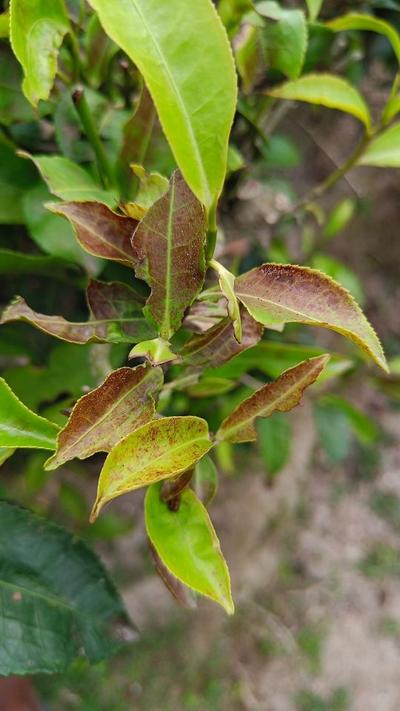
- Yellow spots along leaf midrib, spreading outward. Leaves turn bronze, rust, or purple colour and may fall off. Fine silk webs with tiny red eggs visible under leaves. Very small red mites feed on upper surface of old leaves.
Can also be found in

TEA
Symptoms
The first signs are yellowish spots that appear along the midrib of older leaves. These spots start small but grow bigger and later turn brown and join together to form large patches. As feeding continues, leaves turn bronze, coppery-brown, rust, or purple coloured. The damage usually starts on the upper surface of old leaves in shallow areas along veins and midrib. Under heavy infestations, both upper and lower leaf surfaces get infested and young leaves are affected too. Underneath infested leaves are fine silk webs with tiny red spherical eggs. Severely damaged leaves dry up and fall off the plant. When many leaves fall, tea bushes stop producing new flushes and growth becomes very slow.
Recommendations

Organic Control
Use plant extracts as first treatment option. Preserve natural enemy populations through selective spraying. Combine cultural practices with biological control. Monitor resistance development and adapt chemical choices. Time interventions with seasonal mite population cycles.

Chemical Control
Target egg stage with specific acaricides for best control. Rotate acaricides from different chemical groups to avoid resistance. Apply at first sign of yellow spots. Focus spray on upper leaf surfaces where mites feed. Use lower effective doses to preserve natural enemies. Time applications before dry weather periods.
What caused it?
The symptoms are caused by Red Tea Mites (Oligonychus coffeae) which are tiny 8-legged mites with only 0.3-0.4 mm in size. They are red at the front and reddish-brown or purple at the rear. Adult females, larvae, and nymphs all feed on leaf sap. The mites are active year-round in but follow seasonal patterns. Attacks start when temperatures are mild and build up rapidly as temperature rises. The worst damage happens during hot, dry weather. Once the rainy season starts, most mites get washed off and nearly disappear. They return afterwards but rarely become serious during that period. Cold weather reduces breeding greatly and populations stay very low. Red Tea Mite is the most serious pest of tea in many countries. It can cause severe crop loss if not controlled properly.
Preventive Measures
- Use mite-resistant plants where possible. Practice heavy pruning and defoliation to remove mite colonies. Monitor weekly during peak season looking for symptoms. Maintain good soil moisture during dry periods. Remove heavily infested lower leaves during plucking. Clean tools and clothes when moving between fields. Avoid working in heavily infested areas during windy weather.
Share


More problems onTEA
Download Plantix
